Annual Reports
The Marzetti Company's annual reports contain management's most considered account of the business. These are the sections, passages and visual pages worth opening in the originals preserved in Sources.
The Marzetti Company — FY2025 Annual Report (Form 10-K) — FY2025
First 10-K under the Marzetti name, and the fullest account of a two-segment food business where two customers carry nearly half of sales. · Open the full document →
Item 1. Business — p. 5 · Read the full section →
Management's own framing of what the company is after the June 2025 rename from Lancaster Colony.
Why the Lancaster Colony name was retired and what the company says it now is.
Reflecting the evolution and growth of our company, Lancaster Colony Corporation changed its name to The Marzetti Company effective June 27, 2025. Since the divestiture of our last non-food businesses in 2014, Lancaster Colony Corporation operated as a food-only business best-known by our customers, licensing partners, suppliers, and employees as Marzetti. […] The Marzetti Company, an Ohio corporation, is a manufacturer and marketer of specialty food products for the retail and foodservice channels.
p. 5 · Read in context →
Description of and Financial Information About Business Segments — p. 5 · Read the full section →
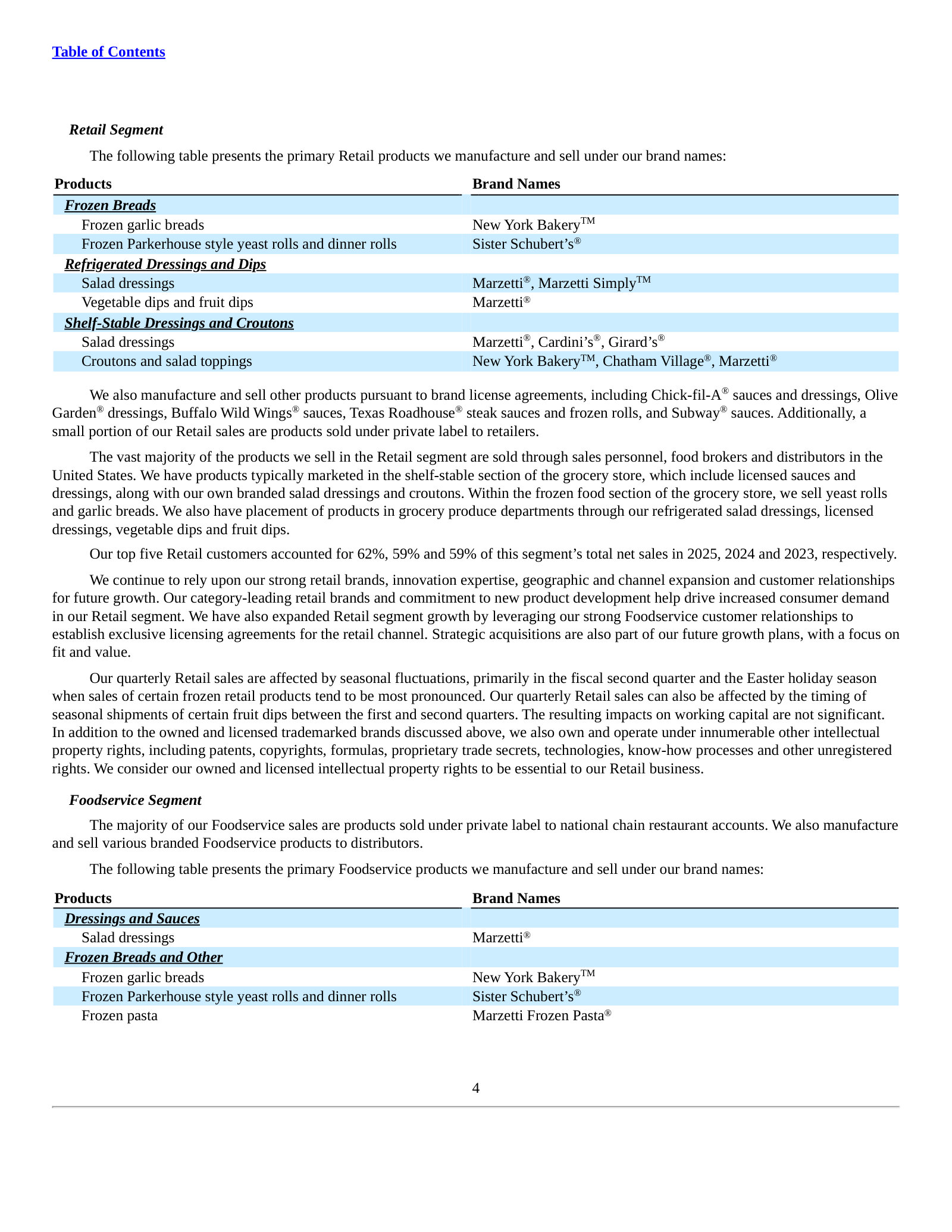
The two segments are built on the same plants but sell in opposite ways — branded shelf space versus private-label chain supply.
Net Sales Attributed to Significant Customer Relationships — p. 7 · Read the full section →
The defining fact of the business: two relationships account for roughly half of consolidated net sales.
Walmart and Chick-fil-A as a share of consolidated net sales, three years.
Net sales attributed to Walmart Inc. (“Walmart”) totaled 19%, 18% and 18% of consolidated net sales for 2025, 2024 and 2023, respectively. […] Total net sales attributed to Chick-fil-A, including the Retail sales resulting from the exclusive license agreement and the Foodservice sales, totaled 29%, 28% and 26% of consolidated net sales for 2025, 2024 and 2023, respectively.
p. 7 · Read in context →
We manufacture and sell numerous products pursuant to license agreements and failure to maintain or renew these agreements could adversely affect our business. — p. 16 · Read the full section →
The licensing program is the stated Retail growth engine, and the agreements behind it are short-dated and cancellable.
Terms on which the brand licences that drive Retail growth can end.
Our brand license agreements are typically for a fixed term with no automatic renewal options or provisions. We cannot ensure that we will maintain good relationships with our brand licensors or that we will be able to renew any of our license agreements upon expiration. Our key brand license agreements can be terminated or not renewed at the option of the licensor upon short notice to us.
p. 16 · Read in context →
Chick-fil-A represents a significant portion of our Foodservice segment sales. — p. 17 · Read the full section →
Quantifies the largest single dependency and notes there is no contractual commitment behind it.
Item 7. Management's Discussion and Analysis — Net Sales — p. 29 · Read the full section →
Management decomposes a 2.0% sales increase into core volume, the exited bakery lines and a temporary supply agreement.
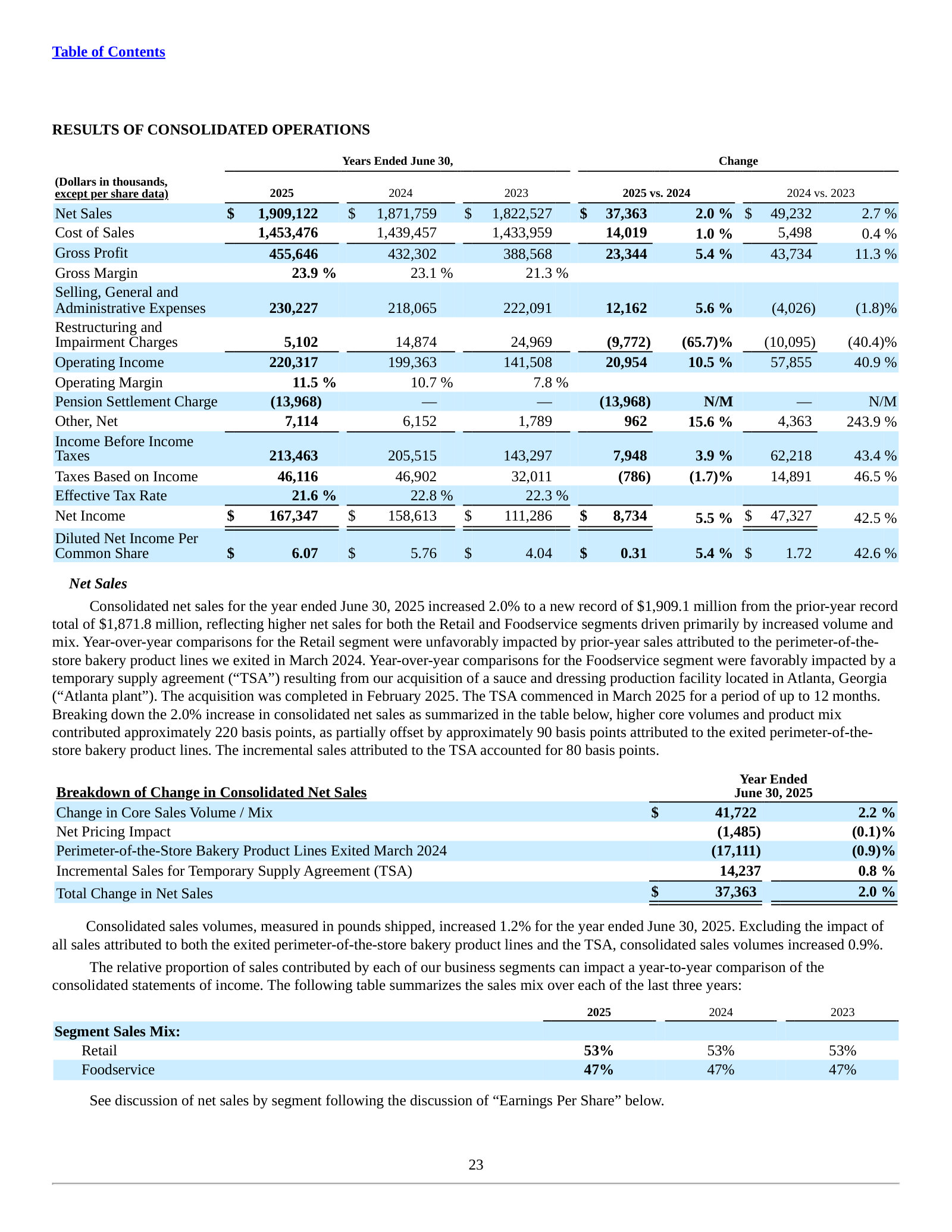
What actually moved sales, with the one-off TSA contribution separated out.
Breaking down the 2.0% increase in consolidated net sales as summarized in the table below, higher core volumes and product mix contributed approximately 220 basis points, as partially offset by approximately 90 basis points attributed to the exited perimeter-of-the store bakery product lines. The incremental sales attributed to the TSA accounted for 80 basis points. […] Consolidated sales volumes, measured in pounds shipped, increased 1.2% for the year ended June 30, 2025. Excluding the impact of all sales attributed to both the exited perimeter-of-the-store bakery product lines and the TSA, consolidated sales volumes increased 0.9%.
p. 29 · Read in context →
Results of Operations - Segments — p. 31 · Read the full section →
Segment-level drivers, including the disclosure that Foodservice volumes fell excluding the temporary supply agreement.
Retail: record sales, with the exited bakery lines distorting the comparison.
In 2025, net sales for the Retail segment reached a record $1,003.4 million, a 1.5% increase from the prior-year total of $988.4 million, reflecting higher sales volumes. Year-over-year comparisons for the Retail segment were unfavorably impacted by prioryear sales attributed to the perimeter-of-the-store bakery product lines we exited in March 2024. Excluding the exited product lines, Retail net sales increased 3.3%. […] Retail segment sales volumes, measured in pounds shipped, increased 1.6%. Excluding the impact of all sales attributed to the exited perimeter-of-the-store bakery product lines, Retail sales volumes increased 2.9%.
p. 31 · Read in context →
Foodservice: menu shifts at two chain accounts, and underlying volumes down 0.3%.
In the back half of the fiscal year, Foodservice segment net sales were unfavorably impacted by menu changes implemented by two of our national chain restaurant customers as they shifted their focus to value offerings. Excluding all sales attributed to the TSA resulting from the February 2025 Atlanta plant acquisition, Foodservice segment net sales increased 0.9%. Foodservice segment sales volumes, measured in pounds shipped, increased 0.9%. Excluding all TSA sales, Foodservice segment sales volumes declined 0.3%. […] In 2025, Foodservice segment operating income increased 14.9% to $111.6 million driven by the beneficial impact of our cost savings programs and cost deflation, as partially offset by higher supply chain costs.
p. 32 · Read in context →
Looking Forward — p. 32 · Read the full section →
Management's own FY2026 setup: modest input inflation to be offset by contractual pricing, and no material tariff impact expected.
FY2026 cost and tariff expectations as stated by management.
With respect to our input costs, in aggregate we anticipate a modest level of inflation in fiscal 2026 that we plan to offset through contractual pricing and our cost savings programs as we remain focused on continued margin improvement in the year ahead. […] While the current tariff environment entails some uncertainty, based on our understanding of currently available information for existing and proposed tariffs, we do not anticipate the performance of our business will be materially impacted by tariffs.
p. 32 · Read in context →
Impact of Inflation — p. 34 · Read the full section →
Explains why Foodservice margins swing more than Retail's — the clearest statement of how cost pass-through actually works here.
Contractual pass-through in Foodservice and the resulting margin volatility versus Retail.
With regard to the impact of commodity and freight costs on Foodservice segment operating income, most of our supply contracts with national chain restaurant accounts incorporate pricing adjustments to account for changes in ingredient and freight costs. […] As a result, the reported operating margins of the Foodservice segment are subject to increased volatility during periods of rapidly rising or falling ingredient and/or freight costs because at least some portion of the change in ingredient and/or freight costs is reflected in the segment’s results prior to the impact of any associated change in pricing. In addition, the Foodservice segment has an inherently higher degree of margin volatility from changes in ingredient costs when compared to the Retail segment due to its overall lower margin profile and higher ratio of ingredient pounds to net sales.
p. 34 · Read in context →
Lancaster Colony Corporation — FY2024 Annual Report (Form 10-K) — FY2024
Included for one section: the FY2024 MD&A is where management explains the portfolio reset that the FY2025 report only references. · Open the full document →
Restructuring and Impairment Charges — p. 30 · Read the full section →
The rationale for exiting the perimeter-of-the-store bakery lines — no scale, no direct-to-store distribution — is stated only here.
Why the Flatout and Angelic Bakehouse acquisitions were unwound.
In 2024, we committed to a plan to exit our perimeter-of-the-store bakery product lines and close our Flatout flatbread facility in Saline, Michigan and our Angelic Bakehouse sprouted grain bakery facility in Cudahy, Wisconsin. Due to a lack of scale and direct-to-store distribution capabilities for these products, we were not able to achieve the desired operational or financial performance. Production at these facilities ceased in March 2024, and we completed the divestiture of the real estate and manufacturing equipment at these locations during the quarter ended June 30, 2024.
p. 30 · Read in context →
More annual reports
Lancaster Colony Corporation — FY2023 Annual Report (Form 10-K) — FY2023 · 84 pages · The margin trough: 21.3% gross margin and the peak year of Project Ascent ERP spending, with the first Flatout impairment. · Open →
Lancaster Colony Corporation — FY2022 Annual Report (Form 10-K) — FY2022 · 78 pages · The inflation shock year, and the last report before the SAP S/4HANA go-live distorted quarterly sales comparisons. · Open →
Lancaster Colony Corporation — FY2021 Annual Report (Form 10-K) — FY2021 · 80 pages · Pre-inflation, pre-ERP baseline, with the acquired bakery brands still presented as part of the growth plan. · Open →