Competition
Competitors describe The Marzetti Company's market in their own filings and calls. These verified passages and visual pages show where their strategies meet, using source documents preserved in Sources.
The Clorox Company (Hidden Valley) (CLX)
The closest head-to-head collision with Marzetti's largest business. Clorox's Food segment is Hidden Valley — dressings, dips, seasonings and sauces — the ranch-anchored shelf and refrigerated dressing set where the Marzetti brand competes for the same shelf, the same promotional dollars and the same consumer. Featured on the Food/Hidden Valley discussion only; Clorox's cleaning, litter, Glad and Burt's Bees businesses are out of scope. Management sizes the salad dressing category, describes the promotional environment inside it, and walks through price-pack and better-for-you innovation moves that map onto Marzetti's own.
Clorox's sizing of the salad dressing category it shares with Marzetti — low single-digit declines with considerable variability — and its stated price-pack response of pushing both larger and smaller Hidden Valley sizes.
Linda Rendle, Chair and CEO — Q&A with Andrea Teixeira (JPMorgan): One area we are closely watching is food. Generally, the overall food category has faced challenges, particularly in the segment we participate in, such as salad dressing, which has experienced low single-digit declines and considerable variability. We've adjusted our strategy accordingly, and you may have noticed in our comments that both large and small package sizes in this business are performing well. This is an example of how we plan to utilize price pack architecture to meet consumer needs, offering a Hidden Valley option that provides the best value per ounce or a more affordable small size for those needing pantry staples for upcoming meals.
p. 2 · Read in context →
Clorox's account of a dressings category running weaker than it planned — a mid-single-digit rather than low single-digit decline, with what it characterises as high promotional intensity and deep discounting by competitors — alongside the pack-size reversal and reformulated launches it credits for its own share inflection.
Linda Rendle, Chair and CEO — Q&A with Peter Grom (UBS): And then the other area I would just call out would be Food. And although we did grow share in the quarter, and we saw portions of the elements of the things we put in place working, the category was weaker than we had expected. So we expected a low single-digit decline. It was closer to a mid-single-digit decline in the category. We're seeing high promotional intensity and deep discounting from competitors in that category, which is putting pressure on dollars. And we're also seeing some consumer trends that we're watching closely on GLP-1s, et cetera. […] But the good news for Hidden Valley is we did some price pack architecture work. I think you all recall, we had made a transition where we flipped our bottle upside down, which was consumer preferred right before last February when kind of value superiority really accelerated from a consumer perspective. So we have since reversed that decision and put our regular 16-ounce bottle that everyone knows and loves back on the shelf. That's playing well. In addition, we've just recently launched a number of trend forward Hidden Valley launches, including protein forward options, Avocado Oil item, and we believe that's why we've seen that inflection in share
p. 2 · Read in context →
Clorox's stated back-half plan for Hidden Valley: price-pack architecture plus an avocado-oil ranch aimed at seed-oil-avoiding consumers — the same better-for-you reformulation ground Marzetti's dressings innovation occupies. (Transcript reads 'nonseed oi'.)
Linda Rendle, CEO — Q&A with Peter Grom (UBS): in other businesses, I would call out Hidden Valley as another where price pack architecture will play a big role in the back half of the year. We think consumers trading up to larger and smaller sizes. So we're addressing that in the back half, as well as a new avocado ranch, which addresses people who are looking for nonseed oi dressings and food items.
p. 3 · Read in context →
McCormick & Company (MKC)
Competes with Marzetti on both sides of its business. In retail, McCormick calls itself one of the brand leaders in U.S. condiments and sauces (French's, Frank's RedHot, Cholula) — the adjacent set to dressings and dips. In foodservice, its Flavor Solutions segment sells customised sauces and flavour systems to restaurant chains and food manufacturers, which is the model Marzetti's foodservice segment runs. Its pending combination with Unilever's Foods business would add Hellmann's mayonnaise and dressings and create a roughly $6bn B2B foodservice platform.
McCormick's own claim to leadership in the U.S. condiments and sauces category adjacent to Marzetti's dressings and dips, and its description of the competitive set as a mix of large manufacturers and small privately-owned suppliers.
FY2025 Form 10-K — Item 1, Business: Consumer Segment: Approximately two-thirds of our Consumer segment sales are spices and seasonings and condiments and sauces. Within the spices and seasoning category, we are the brand leader globally and a category leader in our key markets. In the condiments and sauces category, we are one of the brand leaders globally and in the U.S. There are numerous competitive brands of spices and seasonings and condiments and sauces in the U.S., as well as additional brands in internationa markets. Some are owned by large food manufacturers, while others are supplied by small privately-owned companies. In this competitive environment, we are leading with innovation and brand marketing, applying our analytical tools to help customers optimize the profitability of their sales of these categories, while simultaneously working to increase our own sales and profit.
p. 3 · Read in context →
McCormick's stated scale claim for the foodservice platform it would create by combining with Unilever's Foods business — roughly $6bn of pro forma annual sales — and its front-of-house/back-of-house framing of the channel Marzetti's foodservice segment sells into. (Transcript reads 'globa' and 'back-ofhouse'.)
Brendan Foley, Chairman, President and CEO — prepared remarks on the Unilever Foods transaction: In addition to retail expansion, Slide 13 highlights the power of our combined Food Service platform. Together, we will strengthen the scale business-to-business leader with approximately $6 billion in pro forma annual sales, positioning us among the largest globa food service players. Unilever's Food Solutions brings global presence with deep back-ofhouse capabilities and culinary expertise that meaningfully expands McCormick's reach across multiple food service operators. Complementing that strength, McCormick offers a powerful branded front-of-house presence and an extensive partnership network, particularly across independent non-commercial and chain operators.
p. 3 · Read in context →
McCormick's read on where foodservice demand is still growing — QSR in the Americas, fast casual and non-commercial — against overall pressure on the channel, the same restaurant-traffic exposure that drives Marzetti's foodservice volumes.
Brendan Foley, Chairman, President and CEO — Q&A with Alexia Howard (Bernstein): Yeah, I think that specific about branded food service in your question, the segments in which we're seeing sort of more growth than the total food service industry would be, we're seeing some growth in QSRs, especially in the Americas, and we're seeing growth in fast casual dining. Also, I think one of non-commercial. Those four to five areas is where we are seeing right now, I think, most of the growth in traffic, et cetera. That's the area in which I think we're also finding that our brands certainly can play and resonate or our ability to sort of help with flavor will help there, too. I think overall, though, there certainly has been pressure on the food service marketplace. This element of, especially in the second quarter, just increased pressure on the consumer certainly coming through, not necessarily just food, but many other things that household budgets need. I think that did have an impact on food service to some degree because it did decelerate in the quarter from the first quarter, in our view. There was still growth, and the growth is happening in areas where we have been putting some focus.
p. 13 · Read in context →
Flowers Foods (FLO)
The second-largest U.S. baker and the peer that publishes the clearest picture of the bakery market Marzetti's frozen breads and dinner rolls sit inside. Flowers sizes the U.S. fresh and frozen bakery market, publishes named dollar shares for itself, Bimbo, Pepperidge Farm and private label, ships its own frozen bread and roll products through outside freezer facilities, and supplies breads and rolls to national and regional restaurants and foodservice distributors — the same two channels Marzetti serves.
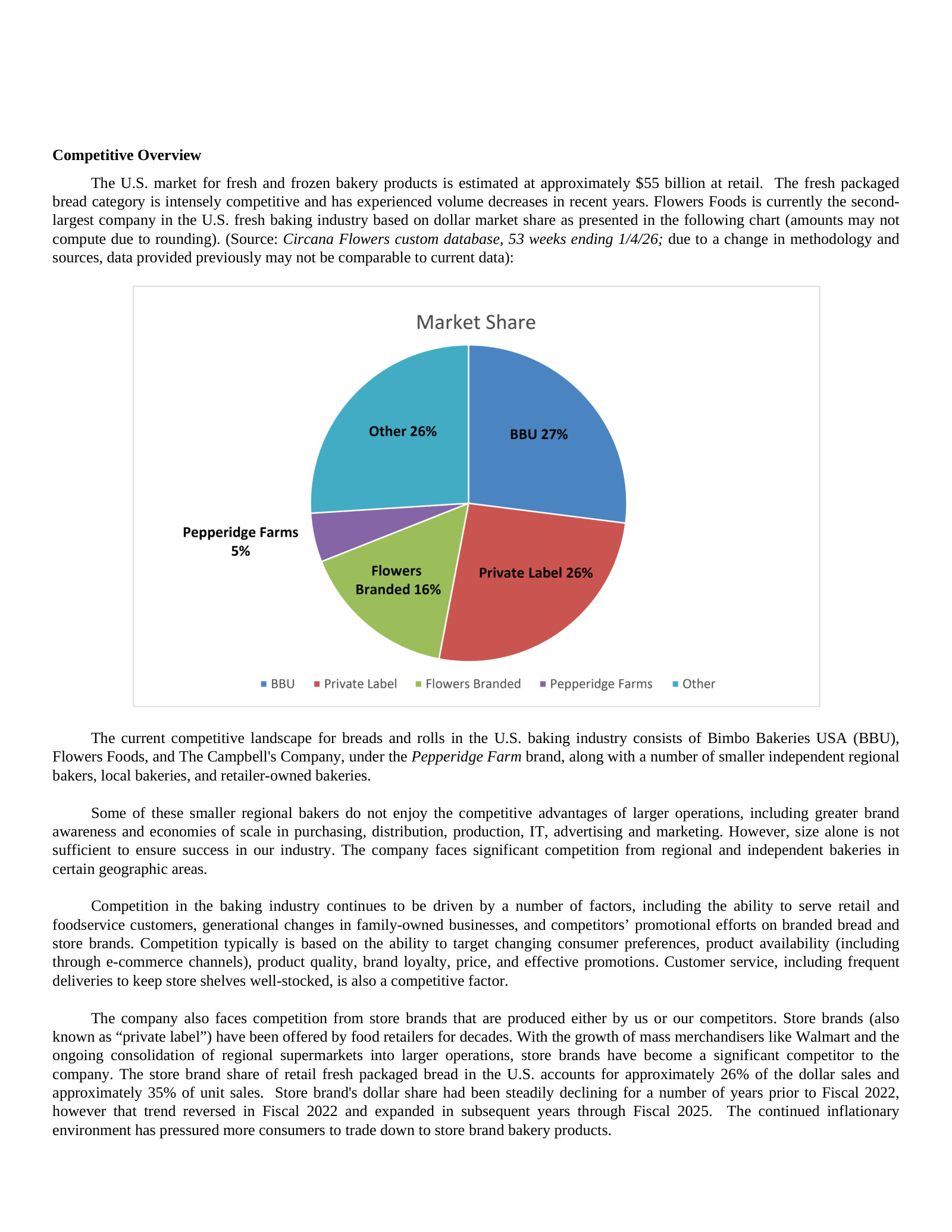
Flowers' description of its restaurant, institutional and foodservice bread-and-roll business, and its acknowledgement that it co-packs for retail customers and for food companies that are themselves competitors — the same blurred supplier/rival line that runs through Marzetti's foodservice and licensing model.
FY2026 Form 10-K — Item 1, Business: Customers: We also (1) supply national and regional restaurants, institutions and foodservice distributors, and retail in-store bakeries with breads and rolls; (2) sell packaged bakery products to wholesale distributors for ultimate sale to a wide variety of food outlets; and (3) sell packaged snack cakes primarily to customers who distribute them nationwide through multiple channels of distribution, including mass merchandisers, supermarkets, vending outlets and convenience stores. In certain circumstances, we enter into co-packing arrangements with retail customers or other food companies, some of which are competitors.
p. 15 · Read in context →
Flowers' account of foodservice weakness tracking restaurant traffic across broadline distribution and QSR, and its observation that private label had gone soft because price gaps to lower-priced branded products narrowed — a read on the trade-down dynamic that also bears on Marzetti's retail brands. The elisions drop an unrelated vending aside and the analyst's interposed follow-up question.
Ryals McMullian, Chairman and CEO — Q&A with James Salera (Stephens): Yes. Jim, the foodservice business has been under pressure, not surprisingly, given the economic environment and consumer sentiment. So that's really all that is. I would continue to note, though, that despite that weakness, the work that we've done over the last 2 to 3 years to improve the profitability of that business is still delivering very nicely on the bottom line. So that's good to see. But we would expect that to recover as the economy recovers. It tends to ebb and flow with that. […] Private label is interesting because it has been weak. You can see that in the syndicated data, which may seem kind of strange given where we are economically. But the price gaps between private label and some of the lower-priced branded products have narrowed significantly. […] Yes. You can look at traffic, which would be a good indicator. And remember, our foodservice business is really broad, right? So it's broad line through the big distributors, but it's also QSR, which has clearly been under pressure. We compete across all those channels. So it's just general weakness across foodservice given the economic environment.
p. 3 · Read in context →
Conagra Brands (CAG)
Overlaps Marzetti in frozen retail and in the custom foodservice manufacturing business, and it runs the same licensed-restaurant-brand playbook. Conagra's Foodservice segment sells customised sauces and custom-manufactured culinary products to restaurants; its Refrigerated & Frozen segment competes for the same freezer set; and it markets retail products under licences from P.F. Chang's and Wendy's, the mirror image of Marzetti's Olive Garden, Chick-fil-A, Buffalo Wild Wings, Arby's, Subway and Texas Roadhouse licences. Featured on those parts; Conagra's snacks and international businesses are out of scope.
Conagra's disclosure of the restaurant and celebrity trademark licences it sells retail product under — the same borrowed-equity model Marzetti runs, and a reminder that these arrangements are negotiated and renewable rather than owned.
FY2026 Form 10-K — Item 1, Business: Trademarks and Intellectual Property: Some of our products are sold under licensing arrangements with others, including our licensing arrangement with Dolly Parton and our licenses of the P.F. Chang’s<sup>®</sup>, Bertolli<sup>®</sup>, Wendy’s<sup>®</sup>, and Libby’s<sup>®</sup> trademarks. […] While many of these licensing arrangements are perpetual in nature, others must be periodically renegotiated or renewed pursuant to their terms.
p. 6 · Read in context →
How Conagra defines its Foodservice segment — customised sauces and custom-manufactured culinary products packaged for restaurants — which is the same custom-manufacturing-for-chains business Marzetti's Foodservice segment runs.
FY2026 Form 10-K — Item 1, Business: Reporting Segments: The Foodservice reporting segment includes branded and customized food products, including meals, entrees, sauces, and a variety of custom-manufactured culinary products packaged for sale to restaurants and other foodservice establishments primarily in the United States.
p. 5 · Read in context →
Conagra's stated approach to the frozen aisle heading into fiscal 2027 — inflation-justified pricing alongside continued brand investment, with guidance assuming higher-than-historical elasticities and mid-single-digit volume declines weighted to frozen.
John Brase, CEO — Q&A with Peter Galbo (Bank of America): Yes. Thanks, Peter. I think over the past couple of years, as you are well aware, we have invested significantly to drive volume improvement and that has yielded solid results, but it has also resulted in significant margin compression. I would tell you as inflation persisted in 2027, we just have to remain agile as we look to offset continued cost pressure. Our first line of defense will always be to use productivity to fight inflation. We are targeting another year of productivity above 4%, but we are also going to have to lean on inflationjustified pricing where necessary, just to give us the fuel that we need to invest in our business and with customers to drive that long-term growth. I would say this is all about balance—ensuring we are priced competitively and also passing along inflation-justified prices where we need to, to give us the ability to drive our brands in the categories that we compete in. I want to make sure you hear something importantly, though: we are not backing off our commitment to frozen. We are making significant incremental investments in brand building, like I just talked about, in fiscal 2027, and we have probably our strongest innovation pipeline in place to delight the consumer. And I think as you think about elasticity we have been very prudent in our elasticity assumptions. Our guidance is assumed higher than historical elasticities with volumes down mid single digits, really weighted towards frozen. So I think we have taken a prudent approach to how we plan the year.
p. 2 · Read in context →
The Kraft Heinz Company (KHC)
Groups condiments, sauces, dressings and spreads into a single 'Taste Elevation' platform — the category Marzetti's retail dressings sit in — and sells through both grocery retail and foodservice distributors, restaurants and institutions. Its away-from-home business, anchored on Heinz, is a direct competitor for the restaurant-chain sauce and dressing volume that Marzetti's foodservice segment supplies. Featured on Taste Elevation and away-from-home; Kraft Heinz's coffee, cheese and meats platforms are out of scope.
Kraft Heinz's own portfolio taxonomy, which places dressings alongside condiments, sauces and spreads in one 'Taste Elevation' platform, and its channel list spanning grocery, foodservice distributors, restaurants and institutions — both of Marzetti's channels in one company.
FY2025 Form 10-K — Item 1, Business: Sales and Customers: Our products are sold through our own sales organizations and through independent brokers, agents, and distributors to chain, wholesale, cooperative, and independent grocery accounts; convenience, value, and club stores; pharmacies and drug stores; mass merchants; foodservice distributors; and institutions, including hotels, restaurants, bakeries, hospitals, health care facilities, and government agencies. […] As of December 27, 2025, we manage our sales portfolio through eight consumer-driven product platforms. A platform is a lens created for the portfolio based on a grouping of consumer needs and includes the following for Kraft Heinz: Taste Elevation, Easy Ready Meals, Substantial Snacking, Desserts, Hydration, Cheese, Coffee and Meats. Taste Elevation includes condiments, sauces, dressings, and spreads.
p. 11 · Read in context →
Kraft Heinz's stated view of the away-from-home channel — under macro pressure but treated as a strategic share-gain target, with an explicit intent to extend Heinz beyond ketchup into mayonnaise and other spreads.
Steve Cahillane, Chief Executive Officer — Q&A with Scott Marks (Jefferies): Yes, Scott. From a macro perspective, away from home is under a fair amount of pressure based on the macroeconomic environment both in this country and around the world. Having said that, we see tremendous opportunities for us in away from home based on the strength of our brands and the opportunities in front of us, and this is one of the areas we are investing in. We see away from home as a strategic outlet and a strategic opportunity for us. We like the momentum that we are building early this year. We see a lot of opportunities both in this country and especially around the world to continue to gain share in away from home. We have one of the greatest away-from-home brands in Heinz, and we can do a lot more in leaning into Heinz—and not just in ketchup. Heinz has been successful in mayonnaise and other spreads as well. There are big opportunities for us to continue to leverage our brands, especially Heinz, as we think about the away-from-home opportunity.
p. 7 · Read in context →
The Campbell's Company (Pepperidge Farm) (CPB)
Named by Flowers Foods as the third player in the U.S. bread and roll competitive set through Pepperidge Farm, whose bakery range — including Farmhouse buns and rolls — competes with Marzetti's Sister Schubert's and New York Bakery lines. Campbell's Meals & Beverages commentary also frames the at-home cooking and premium-sauce trend that underpins Marzetti's licensed restaurant-brand retail products. Featured on the bakery and Meals & Beverages discussion; its salty snacks and soup businesses are out of scope.
Campbell's read on the bakery category — under pressure overall, with consumers being selective and favouring premium differentiated products — and its claim that its own premium innovation is outpacing segment trends.
Mick Beekhuizen, President and CEO — prepared remarks: Within our fresh bakery business, dollar and volume share were both relatively flat. However, the overall category remained under pressure as consumers are more selective in their purchases of fresh bread, favoring premium differentiated products. Our latest innovation in farmhouse thin sliced is outpacing sandwich segment trends, delivering strong repeat rates reflecting consumer demand for healthy products without compromising on taste.
p. 3 · Read in context →
More peer documents
CLX_annual_report_FY2025 — 60 pages · Clorox's 10-K describes Hidden Valley dressings, dips, seasonings and sauces inside its Food segment and claims over 80% of company sales come from No. 1 or No. 2 share brands; the segment note gives Food's sales and margin separately. · Open →
FLO_annual_report_FY2024 — 194 pages · Prior-year Flowers 10-K with the same Competitive Overview section, for a two-year read on how the bakery market size, the named share split and private-label penetration have moved. · Open →
Q4_FY2025 — 12 pages · Campbell's full-year call covers Pepperidge Farm fresh bakery share, Farmhouse buns and rolls momentum, and the premiumisation-plus-value framing across its bakery portfolio. · Open →